Targeting Muscle Knots: How Dry Needling Improves Movement Efficiency
The human body is a marvel of biological engineering, a complex system of levers and pulleys designed for fluid, graceful, and powerful movement. However, even the most finely tuned machines can encounter internal friction. In the muscular system, this friction often manifests as myofascial trigger points, commonly known as “muscle knots.” These knots are more than just localized sore spots; they are physiological disruptions that act as “speed bumps” within your neuromuscular system.
When your muscles are riddled with these points of tension, your movement efficiency plummets. You burn more energy to perform simple tasks, your range of motion becomes restricted, and your risk of injury increases. While traditional therapies like stretching and massage have their place, they often struggle to reach the deep-seated tension held within the core of a muscle fiber. This is where dry needling comes in—a clinical intervention designed to “reset” the muscle from the inside out.
By directly influencing the muscle at its deepest level, dry needling does more than just alleviate pain—it reboots the muscle’s ability to function. In this comprehensive guide, we will explore the science of muscle knots, the mechanics of dry needling, and how this treatment serves as a catalyst for peak movement efficiency.
Part I: The Anatomy of a Muscle “Knot”
To fix a musculoskeletal problem, one must first understand its biological origin. A “muscle knot” is not a literal entanglement of tissue. Instead, it is a myofascial trigger point—a hyperirritable spot located within a taut band of skeletal muscle fibers.
Physiologically, these points occur when sarcomeres—the microscopic units of muscle contraction—become stuck in a persistent “on” position. This localized contraction creates a nodule that is palpable to the touch and tender upon pressure. Because the fibers remain clenched, they compress nearby capillaries, restricting blood flow and trapping metabolic waste, which perpetuates a cycle of pain and stiffness.
The Physiology of Contraction
In a healthy muscle, fibers glide past one another smoothly. When you decide to move, your brain sends an electrical signal through the nervous system, releasing a neurotransmitter called acetylcholine. This chemical causes the muscle fibers to contract. Once the movement is over, the fibers relax and return to their resting length.
In a trigger point, this “relaxation” phase never happens. A small patch of muscle fibers remains in a state of constant, involuntary contraction.
The Metabolic Crisis
Because the muscle is perpetually contracted, it puts pressure on the surrounding capillaries. This creates a localized “metabolic crisis”:
1. Ischemia: The squeezed blood vessels cannot deliver fresh, oxygenated blood to the area.
2. Hypoxia: The tissue becomes starved of oxygen.
3. Waste Accumulation: Without proper blood flow, metabolic byproducts like lactic acid and “Substance P” (a pain-signaling chemical) cannot be flushed away.
This creates a self-sustaining cycle of pain. The acidity from the waste products irritates the local nerves, which causes the muscle to contract even harder as a protective mechanism, further cutting off blood flow.
Local vs. Referred Pain
One of the most frustrating aspects of trigger points is referred pain. A knot in your neck might cause a headache; a knot in your glutes might cause pain that radiates down your leg, mimicking sciatica. This occurs because the constant sensory input from the knot “confuses” the spinal cord, causing pain signals to be felt in areas distant from the actual source.
Part II: The Science of Dry Needling
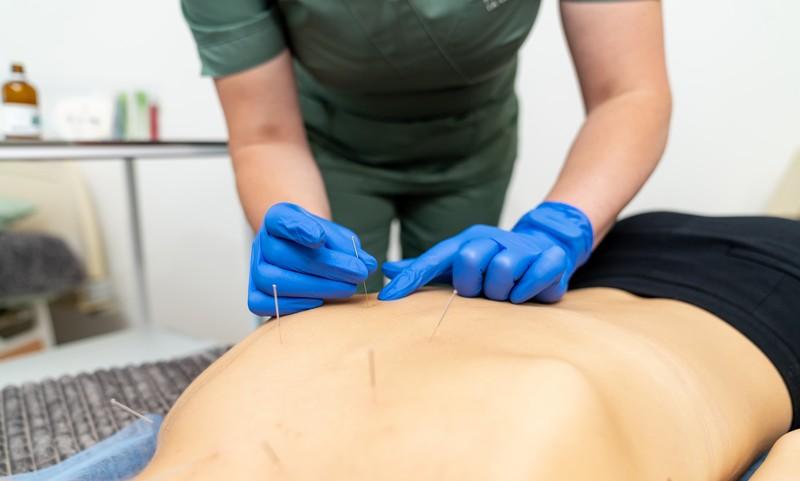
Dry needling is a sophisticated medical intervention specifically engineered to treat myofascial pain and neuromuscular dysfunction. The term “dry” distinguishes this procedure from traditional injections, as no medication or fluid is introduced into the body. Instead, the sterile, solid filiform needle itself serves as the primary therapeutic tool.
The process involves precisely inserting the needle into a documented trigger point to elicit a “local twitch response.” This involuntary reflex effectively resets the dysfunctional muscle fibers. By physically disrupting the persistent contraction, dry needling normalizes the chemical environment surrounding the nerve endings, rapidly reducing localized tension and restoring healthy muscle function.
Western vs. Eastern Medicine
It is important to distinguish dry needling from acupuncture. While both use thin, stainless steel needles, their foundations differ:
- Acupuncture is based on Traditional Chinese Medicine (TCM). It aims to balance the flow of energy (Qi) along meridians or pathways in the body.
- Dry Needling is based on Western medicine, anatomy, and neurophysiology. It targets specific anatomical structures—muscles, tendons, and ligaments—to elicit a physiological change.
The Local Twitch Response (LTR)
The “magic” of dry needling lies in the Local Twitch Response. When the needle is inserted directly into a trigger point, it causes a brief, involuntary contraction of the muscle fibers. This twitch is the clinical “reset button.”
Research shows that the moment a twitch occurs:
The concentration of inflammatory chemicals in the area drops immediately.
The electrical activity in the muscle (the “noise” telling it to contract) significantly decreases.
The muscle fibers are mechanically disrupted, forcing them to let go of their clenched state.
Part III: The Road to Movement Efficiency
Movement efficiency is the body’s ability to execute tasks with minimal energy expenditure and maximum functional output. For athletes, efficiency translates to superior speed and explosive power; for office professionals, it means completing a workday without the burden of tension headaches or spinal stiffness.
Muscle knots act as internal “parking brakes,” forcing the body to overcompensate and leak energy through poor mechanics. Dry needling removes these biomechanical obstructions by restoring optimal muscle length and improving neurological firing. By smoothing out these “kinks” in the kinetic chain, you achieve fluid, effortless movement and reduced injury risk.
Muscle knots are the primary enemies of efficiency. Here is how dry needling restores the body’s natural mechanics:
1. Restoring Optimal Length-Tension Relationships
Every muscle has an “optimal length” where it can produce the most force. A knotted muscle is a shortened muscle. When a muscle is stuck in a shortened state, it cannot generate power effectively. This is why you might feel “weak” even if you have large muscles. Dry needling releases the knot, allowing the muscle to return to its natural length, which immediately improves your strength and power output.
2. Eliminating Energy “Leaks”
Imagine driving a car with the parking brake slightly engaged. You can still drive, but you have to push the gas pedal harder, and you’re wearing out the engine. Muscle knots are your body’s “parking brakes.” When one muscle is tight, other muscles have to work overtime to compensate. This is called “synergistic dominance.” By releasing the primary knot, dry needling allows your body to stop fighting itself, saving energy for the movements that actually matter.
3. Improving Proprioception and Coordination
Your brain relies on sensors in your muscles (called muscle spindles) to know where your limbs are in space. Constant tension in a knot “blurs” this feedback. It’s like trying to listen to music through heavy static. By quieting the electrical noise in the muscle, dry needling clears the communication lines between your brain and your body, leading to better balance, coordination, and technique.
4. Enhancing Blood Flow and Recovery
The “flushing” effect of dry needling brings fresh, nutrient-rich blood back into the muscle. This doesn’t just help the knot; it helps the entire limb recover faster from training. Improved circulation means faster repair of micro-tears and more efficient removal of the metabolic trash that causes delayed onset muscle soreness (DOMS).
Part IV: Common Areas Targeted for Efficiency
Different regions of the body respond exceptionally well to dry needling to improve specific movement patterns:
The Hips (Glutes & Psoas): Essential for runners and lifters. Releasing hip knots improves stride length and allows for a deeper, safer squat.
The Upper Back (Trapezius & Levator Scapulae): Crucial for anyone who spends time on a computer. Releasing these knots prevents the “hunched” posture that leads to neck pain and restricted shoulder movement.
The Lower Leg (Gastrocnemius & Soleus): For those suffering from “tight calves” or plantar fasciitis, dry needling can restore the ankle mobility needed for walking and jumping.
The Forearms: Vital for grip strength and preventing “tennis elbow” or “golfer’s elbow” in overhead athletes and manual laborers.
Part V: What to Expect During and After Your Session
The Procedure
The treatment usually takes 15 to 30 minutes. Your provider will palpate the muscle to find the exact location of the trigger point. A sterile, single-use needle is then tapped through the skin. You may not even feel the needle enter. However, when the needle reaches the knot, you will likely feel a deep ache or the signature “twitch.” This sensation is often described as a “good hurt” because it signals that the tension is being released.
The Recovery
Post-needling soreness is normal. It typically feels like the muscle soreness you experience after a very intense workout.
Hydration: Drinking plenty of water helps flush out the toxins released from the knot.
Movement: Light stretching or a walk is recommended to keep the blood flowing and prevent the muscle from stiffening back up.
Heat: Applying heat to the area can soothe post-treatment soreness.
Most patients notice an immediate improvement in their range of motion, with the full benefits of reduced pain and improved efficiency appearing 24 to 48 hours after the soreness fades.
Frequently Asked Questions (FAQs)
Is dry needling safe? Yes, when performed by a trained and licensed professional, dry needling is extremely safe. We use sterile, medical-grade needles, and our clinicians have deep expertise in human anatomy to ensure precision.
How is this different from a deep tissue massage? Massage works from the outside in, using pressure to move tissue. Dry needling works from the inside out. A needle can reach deep muscles (like the psoas or piriformis) that are physically impossible to reach effectively with a therapist’s hands or a foam roller.
How many treatments will I need? This varies depending on the chronicity of the issue. Acute injuries might resolve in 1–2 sessions. Long-standing, chronic movement patterns may require 4–6 sessions combined with corrective exercises to “train” the brain to use the newly released muscle correctly.
Can I get dry needling if I am an athlete in mid-season? Absolutely. Many professional athletes use dry needling as part of their maintenance routine to stay “loose” and prevent small knots from becoming major strains. We simply recommend timing the session so you have 24 hours of recovery before a major competition.
Will I bleed? Because the needles are so thin, bleeding is minimal to non-existent. Occasionally, a small bruise may form at the site, which is harmless and resolves quickly.
Does insurance cover dry needling? Coverage varies by plan. Many patients find that dry needling is a highly cost-effective treatment because it often resolves issues faster than traditional physical therapy alone. Our office can help you verify your specific benefits.
Conclusion: The Path to Peak Performance
Movement is a fundamental part of the human experience. Whether you are aiming for a personal best in the marathon, trying to lift your grandchildren without pain, or simply looking to get through a workday without stiffness, your movement efficiency is the key.
Muscle knots are not a life sentence. They are simply a sign that your body’s “wiring” has become tangled. Dry needling provides a precise, scientifically-backed method to untangle those wires, release the “parking brakes” on your performance, and restore the fluid, effortless movement you were born with.
At Elite Spine & Health Center, we don’t just treat symptoms; we optimize human function. By combining dry needling with expert chiropractic care, we help you clear the path to a stronger, more efficient version of yourself.
Take the First Step Toward Better Movement
Don’t let muscle knots dictate your limits. Experience the difference that precision care can make in your daily life and athletic pursuits.
📍 Address: Elite Spine & Health Center – Spring 18425 Champion Forest Dr, Suite 200 Spring, TX 77379 Located on the 2nd floor, behind Bank of America
📞 Phone Number: 346-808-8338 Call us today for appointments and inquiries.
🌐 Website: elitespinehouston.com
Elite Spine & Health Center Your partner in movement, health, and recovery.